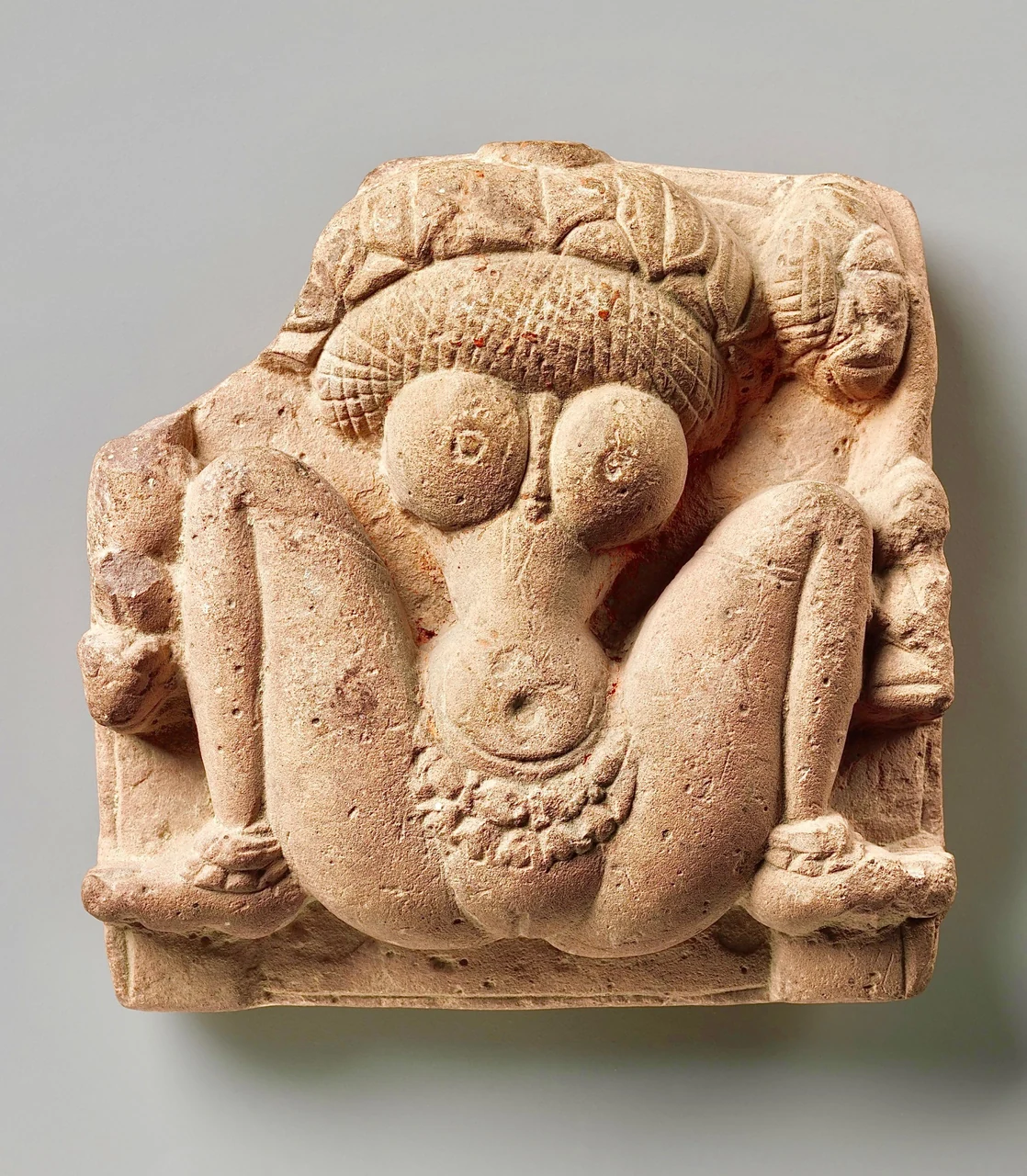
Lotus-Headed Fertility Goddess Lajja Gauri. India (Madhya Pradesh), ca. 6th century, sandstone. The Metropolitan Museum of Art, 2000.284.13. Public domain image.
A brief history of Yoni massage: from symbol to contemporary practice
The word yoni and some of the symbols associated with Yoni massage have a long history. The sources below document that history, but do not establish that massage as offered today was practised in the same form in temples in India or China.
Yoni, Tantra and South Asian imagery
In Sanskrit, yoni can mean womb, matrix or place of origin. It can also have symbolic meaning in religious contexts. Tantric traditions developed in early medieval India in Hindu and Buddhist settings, with a range of texts and ritual practices. Sexuality appears in some contexts, but it does not define Tantra as a whole.
The opening sculpture belongs to Indian fertility imagery. The lotus in place of the head is one of the features the Metropolitan Museum of Art draws on to interpret the figure of Lajja Gauri. The piece helps explain the symbolic context, but cannot tell us how a massage technique was performed or by whom.
The “wandering womb” in ancient Greece
In the Timaeus (91c), Plato describes the womb as capable of wandering through the body and causing illness. This passage reflects an ancient understanding of the female body. It does not describe anatomy or document Yoni massage in Greece.
“Hysteria” and the story about vibrators
In Western medicine, “hysteria” was used at different times to group a wide range of symptoms and behaviours. Interpretations changed over time and often reflected biases about women’s bodies and sexuality.
A widely repeated story claims Victorian doctors used vibrators to induce orgasm and treat hysteria. Historians Hallie Lieberman and Eric Schatzberg re-examined the sources cited for the claim and challenged whether they document that practice. The story remains disputed and does not establish an origin for Yoni massage.
How the contemporary account took shape
Tantra has been reinterpreted in modern settings. The British Museum exhibition curated by Imma Ramos traces its transformations through to twentieth-century counterculture. Today, “Yoni massage” may refer to different offerings. To understand what a session involves, look at how it is described, how boundaries are agreed and how consent is handled.
Yoni massage, consent and support after trauma
At Tantra del Sole, Yoni massage is offered as a wellbeing practice. The practitioner remains clothed, boundaries are agreed before the session, and you can ask to pause or stop contact. If you are affected by trauma or abuse, a qualified mental health professional can help you assess what support would suit you. NICE guidance describes specific clinical approaches for post-traumatic stress disorder.
The history of these symbols can deepen your curiosity. To make an informed choice today, start with a practical question: what happens during a session and how will my boundaries be respected? What is Yoni massage?
Sources
The history of Yoni massage through Indian symbolism, stories about hysteria and contemporary interpretations of Tantra.